Dates and mintmarks
 |
While some wire coins have dates corresponding to the putative years of mintage, not all do. Those that don't will correspond to either a specific year or range of years. Those that do will have their dates written using Cyrillic numerals, which represent the Byzantine year for coins prior to 1700 and the Julian year for coins after. This calendar reform was one of Peter the Great's earliest reforms.
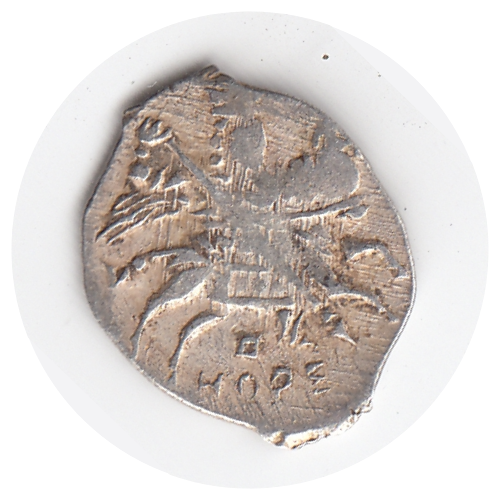
Dates, when present, are below the horse, and useful in expediting coin identification, especially for those of Peter the Great, only some of which are covered by the aforementioned identification charts. Mintmarks indicating the city of minting, when present, are also below the horse, the mintmark before the date when both are present. As in the above example of the "smaller kopek of Peter the Great," however, often a die with a date strikes a coin in a way such that the date itself is missing.
Dates first appeared on Novgorod-minted coins in 1596 (Byzantine year 7104) and were present in them for years. This was due to a monetary reform that came after the increased trade resulting from the end of the 1590-1595 war with Sweden. Outside of Novgorod during this period, the only dated coins were from Pskov in 1599, and even some of those with Pskov mintmarks were actually made in Novgorod. When the 1610-1617 Ingrian War saw Sweden conquering Novgorod in 1611, it was only the Swedes overseeing dated "Russian" coinage. They did not retain accurate years of mintage, as noted in the chart below. Thus Byzantine year 7118 (1610) was the last date on Novgorod wire coins.
After the Swedish occupation of Novgorod ended in 1617, one Novgorod-minted design continued to have an incorrect date (1610) for nearly a decade, minted alongside dateless coins. Thus wire coins have no dates between Byzantine years 7118 and 7204 (1610 and 1696).
Starting with the inception of Peter the Great's solo reign in 1696, all coins – more accurately, all dies – had dates on them. Dates are often not the full numerical date; the millennium can be implied. Even when its value is expressed, the thousands symbol "҂" may be present, absent, or combined with the first numeral. Also, since Byzantine and Julian years do not perfectly align with Western (Gregorian) years, everyone just uses the nearest approximation, e.g., 1596 for the Byzantine year that began in September 1595. During the time of Peter the Great, coins minted at the Kadashevsky Mint (1701-1737, located in Kadashevskaya Sloboda, across the Moskva River from the Kremlin) had the millennium indicator ("а"), while coins minted at the Old Mint (possibly 1535-1717, near St. Basil's Cathedral‡) only sometimes did (as "Я" or "А").
Date marks
Below is a table mapping Cyrillic dates to Gregorian years; some dates do not correspond to exact year of coinage due to the chaos of the Time of Troubles.
| Cyrillic number | Corresponding year | Gregorian year | Notes |
|---|---|---|---|
| РД | 7104 | 1596 | "НОРД" with Novgorod mintmark |
| РЕ | 7105 | 1597 | "НОРЕ" with Novgorod mintmark |
| РЅ | 7106 | 1598 | "НОРЅ" or "ПРЅ" with mintmark |
| РЗ | 7107 | 1599 | "НОРЗ" or "ПСРЗ" with mintmark |
| РИ | 7108 | 1600 | "НОІРИ" with Novgorod mintmark |
| РѲ | 7109 | 1601 | "НОРѲ" with Novgorod mintmark |
| РІ | 7110 | 1602 | "НОРІ" with Novgorod mintmark |
| РАІ | 7111 | 1603 | "НОРАІ" or "НРАІ" with Novgorod mintmark |
| РВІ | 7112 | 1604 | mintmark "Н" above date |
| РГІ | 7113 | 1605 | "НРГІ" with Novgorod mintmark; Swedes also used this date 1616-1617 |
| РДІ | 7114 | 1606 | mintmark "Н" above date |
| РЕІ | 7115 | 1607 | printed as "Н" above "РϜІ" |
| РЅІ | 7116 | 1608 | mintmark "Н" above date |
| None | None | various | "НРД" is not a date, but a mintmark for Novgorod, used in 1609 and 1611 |
| РИІ | 7118 | 1610 | printed as "РІН"; Swedes also used "РІН" 1611-1615, as did one design from Novgorod 1618-1627 (KG#647) |
| СД | 7204 | 1696 | has "Г." suffix for "year" |
| СЕ | 7205 | 1697 | |
| СЅ | 7206 | 1698 | |
| СЗ | 7207 | 1699 | |
| СИ | 7208 | 1700 | |
| ЯΨ | 1700 | 1700 | "Я" can be "А" |
| ЯΨЯ | 1701 | 1701 | "Я" can be "А," "а" for Kadashevsky Mint |
| ЯΨВ | 1702 | 1702 | "Я" can be "А," "а" for Kadashevsky Mint |
| ЯΨГ | 1703 | 1703 | "Я" can be "А," "а" for Kadashevsky Mint |
| ЯΨД | 1704 | 1704 | "Я" is "а" for Kadashevsky Mint |
| аΨЕ | 1705 | 1705 | only minted at Kadashevsky |
| ЯΨЅ | 1706 | 1706 | "Я" is "а" for Kadashevsky Mint |
| аΨЗ | 1707 | 1707 | only minted at Kadashevsky |
| аΨИ | 1708 | 1708 | only minted at Kadashevsky |
| ЯΨѲ | 1709 | 1709 | "Я" is "а" for Kadashevsky Mint |
| ЯΨІ | 1710 | 1710 | "Я" is "а" for Kadashevsky Mint |
| ΨЯІ | 1711 | 1711 | preceded by "а" for Kadashevsky Mint |
| ΨВІ | 1712 | 1712 | only minted at the Old Mint |
| аΨГІ | 1713 | 1713 | only minted at Kadashevsky |
| ΨДІ | 1714 | 1714 | only minted at the Old Mint |
| ΨЕІ | 1715 | 1715 | only minted at the Old Mint |
| ΨЅІ | 1716 | 1716 | preceded by "а" for Kadashevsky Mint |
| ΨЗІ | 1717 | 1717 | "аΨІЗ" for Kadashevsky Mint |
Digression: Mint locations
 |
‡ What Google Maps refers to as the "Old Mint" is actually the newer "Red Mint," which, like the Kadashevsky Mint, opened later than the older Old Mint, during the time of Peter the Great. Google Translate calls the newer mint "Chinese," but that's due to its location, Kitay-gorod, the center-most area of Moscow; "kitay" is the modern Russian word for "China", although its meaning in the context of "Kitay-gorod" is unclear, much like the origin of the word "kopek" itself.
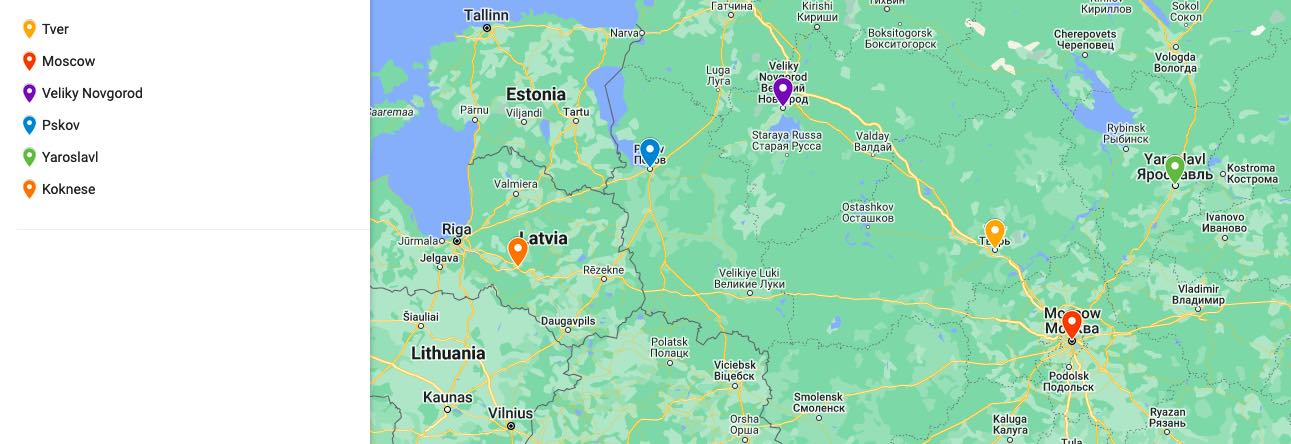
The exact location of older mints (KML, e.g., for Google Earth) outside of Moscow, if indeed they had static locations, appears lost to history, or at the very least obscure. Even the exact location of Moscow's Old Mint seems unclear; Russian-language Wikipedia, which specifies exact locations for other Moscow mints, only says it is was on Ulitsa Varvarka, a short street starting at the famed St. Basil's Cathedral. Also, although Russian-language Wikipedia states that the Old Mint closed down in the 17th century, Kleshchinov and Grishin state that kopeks dated up through 1717 ("ΨЗІ") are from this mint.
Before Peter's time, there were also two short-lived mints that primarily minted the copper wire kopeks that replaced silver from 1655 to 1663. The New Moscow English Mint – or just "New Mint" – was located just steps outside of Kitay-gorod in the Basmanny District. Opened in 1654, it was designed to mint round coins, but a lack of skilled workers meant that, starting from 1655, it only minted copper wire coins, ceasing operations upon the 1663 return to silver. The eponymous English, the property's original inhabitants, had been kicked out of Moscow in 1649 due to the execution of King Charles I.
In addition to this New Mint, the Old Mint, the Pskov mint, and the Novgorod mint, copper wire coins were also briefly minted in Kukeinos mint. Now called Koknese, Latvia, in 1656 Kukeinos was a Swedish fortress captured by Russia, minting copper wire coins from 1659 until its return to Sweden in 1661.
Russian coins were also minted in Tver from the time of its seizure in 1485 to well into the reign of Ivan IV. Coins in the Russian style were also minted outside of Russia by neighbors like Denmark and Sweden. Considered "counterfeit," these are also collectable and relatively rare.